

How to Start Coding as a Beginner: A Complete Guide to Learn Coding From Scratch
 GetTechByte

Learning to code can feel difficult when you are starting from zero. You may see programmers writing hundreds of lines of code and wonder, “How am I ever going to learn this?” The good news is that you do not need to be a computer expert to learn coding. You do not need an advanced mathematics degree or expensive software. You mainly need patience, regular practice and a clear learning path.
In this guide, we will explain how to start coding as a beginner, what programming actually means, which programming language you should learn first, what tools you need, how to practice and how to build your first project. Whether you have never written a single line of code or you are confused about where to begin, this guide will help you understand the basics.
What Is Coding?
Coding is the process of writing instructions that a computer can understand and execute. Computers are extremely powerful but they do not understand normal human instructions in the same way that people do. You can't just talk to a computer like you talk to a friend. Instead, you write clear, step-by-step instructions using a programming language so the computer knows exactly what action to take.
For example, imagine you want a computer to add two numbers.
In Python, you could write:
number1 = 10
number2 = 20
result = number1 + number2
print(result)
The computer follows these instructions and displays:
30
This is coding.
In simple words: Coding means giving instructions to a computer using a programming language.
Programming languages include Python, JavaScript, Java, C++, C#, Go, Rust and many others. You do not need to learn all of them. As a beginner, your goal should be to learn one language well enough to understand programming fundamentals.
Why Should You Learn Coding?
There are many reasons to learn coding.
1. You Can Build Things
Coding allows you to create:
- Websites
- Mobile applications
- Games
- Desktop applications
- Automation tools
- Chatbots
- Data analysis programs
- Artificial intelligence applications
- Business tools
Instead of only using technology, you can learn how to create it.
2. Coding Can Help Your Career
Programming skills are useful in many technology careers, including:
- Software developer
- Web developer
- Mobile app developer
- Data analyst
- Data scientist
- AI/ML engineer
- Automation engineer
- Cybersecurity professional
- DevOps engineer
You don't have to decide your career path on your first day of learning. Start with the basics and explore different areas later.
3. Coding Improves Problem-Solving
Coding teaches you to break a large problem into smaller pieces. For example, instead of thinking:
"I need to build a website."
You can break it down into:
- Create the page structure.
- Add headings.
- Add images.
- Add buttons.
- Add navigation.
- Add styling.
- Make the page responsive.
- Add interactive features.
This way of thinking can be useful outside programming too.
Is Coding Difficult for Beginners?
Coding can be challenging, but it is absolutely learnable. One of the biggest problems beginners face is not the programming language itself. It is often trying to learn too much at once.
A beginner may search for:
"Best programming language"
Then see Python, JavaScript, Java, C++, C#, Go, Rust, PHP, Swift and many others.
This can create confusion. The better approach is:
Choose one language and learn its fundamentals first. You don't need to become an expert immediately. Your first goal should simply be understand how programs work and learn how to write small programs yourself.
What Should You Learn Before Coding?
You don't need advanced knowledge before starting.
A beginner mainly needs:
Basic computer skills
You should know how to:
- Create folders
- Create and save files
- Install applications
- Use a web browser
- Copy and paste text
- Search for information
That's enough to begin.
You don't need to know advanced mathematics. You don't need to understand how computer processors work. You don't need to build a computer. You can learn those subjects later if your career requires them.
How to Choose Your First Programming Language
Choosing a first language can seem complicated.
The best language depends on what you want to build.
| Goal | Good Starting Choice |
|---|---|
| Website | HTML, CSS, JavaScript |
| Web applications | JavaScript |
| Data analysis | Python |
| Artificial intelligence | Python |
| Automation | Python |
| Android development | Kotlin |
| iPhone development | Swift |
| Game development | C# or C++ |
| Systems programming | C or Rust |
Python vs JavaScript for Beginners
Two popular choices for beginners are Python and JavaScript.
Choose Python if you want to:
- Learn programming fundamentals
- Work with data
- Explore artificial intelligence
- Automate repetitive tasks
- Build simple applications
- Start with relatively readable syntax
Choose JavaScript if you want to:
- Build websites
- Create interactive web pages
- Develop web applications
If you don't know what you want to build yet, Python is a reasonable first choice. However, there is no universal "best" programming language. The best language is the one you actually practice consistently.
How to Start Coding Step by Step
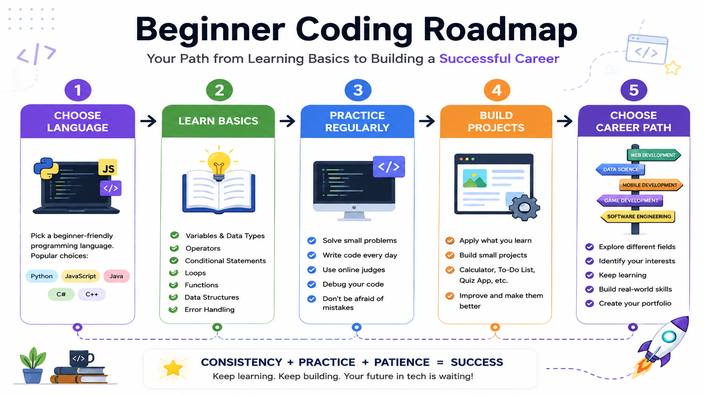
Now let's get into the practical part. Here is a simple roadmap:
Choose a language
↓
Install a code editor
↓
Write your first program
↓
Learn variables
↓
Learn data types
↓
Learn operators
↓
Learn conditions
↓
Learn loops
↓
Learn functions
↓
Learn data structures
↓
Practice with small projects
↓
Build your own projects
Let's look at each step.
Step 1: Understand Basic Programming Concepts
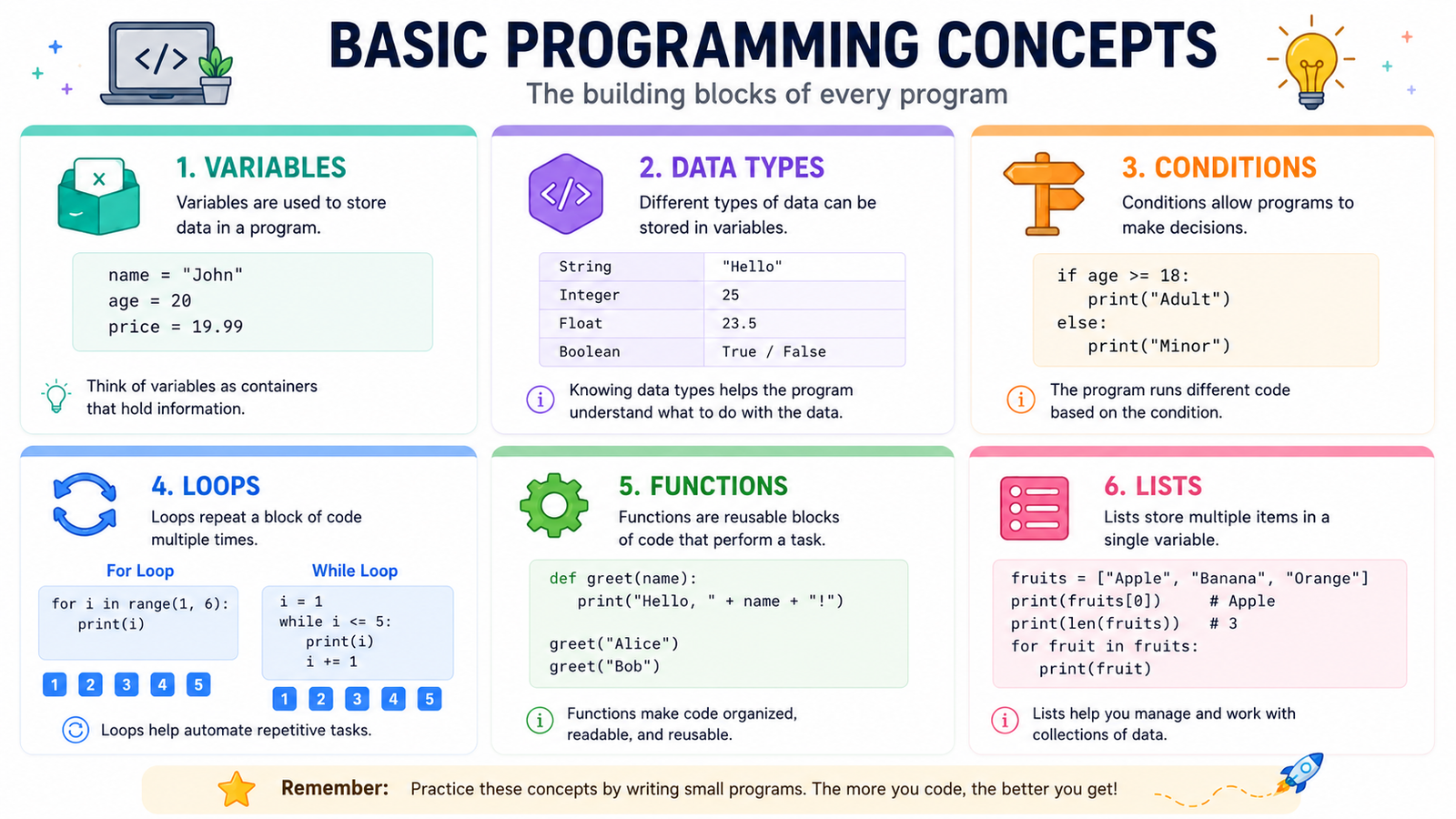
Before trying to build a large application, understand these concepts:
- Variables
- Data types
- Operators
- Conditions
- Loops
- Functions
- Lists
- Dictionaries
- Input and output
- Errors
- Basic problem-solving
These concepts appear in many programming languages.
Once you understand them, learning another language becomes much easier.
How to Practice Coding
Watching tutorials is useful, but watching tutorials alone will not make you a programmer. You need to write code yourself.
A good learning cycle is:
Learn
↓
Practice
↓
Make mistakes
↓
Debug
↓
Understand
↓
Build something
↓
Repeat
For example, after learning variables, don't immediately watch another one-hour video. Try creating something yourself.
Make a program that asks for:
- Your name
- Your age
- Your favourite food
Then display the information.
Beginner Coding Projects
After learning the basics, start building small projects.
Here are some beginner-friendly ideas.
- Calculator
- Number Guessing Game
- To-Do List
- Password Generator
Don't Start With a Huge Project
A common beginner mistake is trying to build something huge immediately.
For example:
"I'm going to build the next Instagram."
That sounds exciting, but it can quickly become overwhelming. Instead, build something you can finish in a few hours or days.
Start with:
Small project
↓
Slightly bigger project
↓
More complex project
↓
Real-world application
Finishing small projects gives you confidence and teaches you how programming works in practice.
What to Learn After Coding Basics
Once you understand programming fundamentals, choose a direction.
If You Want to Build Websites
Learn:
- HTML
- CSS
- JavaScript
- Git
- A frontend framework such as React
- Backend development
- Databases
If You Want to Become a Python Developer
Learn:
- Python fundamentals
- Object-oriented programming
- Git
- Databases
- APIs
- Testing
- A Python framework such as Django or FastAPI
- Deployment
If You Want to Explore Data Science
Learn:
- Python
- NumPy
- pandas
- Data visualization
- Statistics
- SQL
- Machine learning
If You Want to Explore Artificial Intelligence
Learn:
- Python
- Programming fundamentals
- Data structures
- Mathematics and statistics
- Machine learning
- Deep learning
- AI tools and frameworks
Don't jump directly into advanced AI if you don't understand basic programming. Strong fundamentals make advanced topics much easier.
Final Thoughts
Starting coding can feel overwhelming, especially when you see the huge number of programming languages, frameworks, tools, and technologies available. But you don't need to learn everything. Start small choose one programming language. Learn the fundamentals. Write code every day or as regularly as you can. Make mistakes. Read error messages. Build small projects and gradually make them more complicated. The most important thing is to practice instead of only watching tutorials. Your first program may be only a few lines long. Your second project may be a small calculator. Later, you might build websites, applications, games, automation tools, or much larger software projects. Every experienced programmer started somewhere. The goal isn't to become an expert overnight. The goal is simply to write your next line of code.
Start small, practice consistently, and keep building. That's how you learn to code.
Questions
Can I learn coding if I have never coded before?
Yes. You can start coding with no previous programming experience. Begin with basic concepts and practice regularly.
How long does it take to learn coding?
There is no fixed time. With consistent practice, you can learn fundamental programming concepts within a few months, but becoming highly skilled takes much longer.
Can I learn coding without a computer science degree?
Yes. Many programming skills can be learned through self-study, courses, documentation, projects and practice.
Which programming language should a beginner learn first?
Python is a popular starting point because its syntax is relatively easy to read and it is used in many areas. JavaScript is another strong option if your main goal is web development.